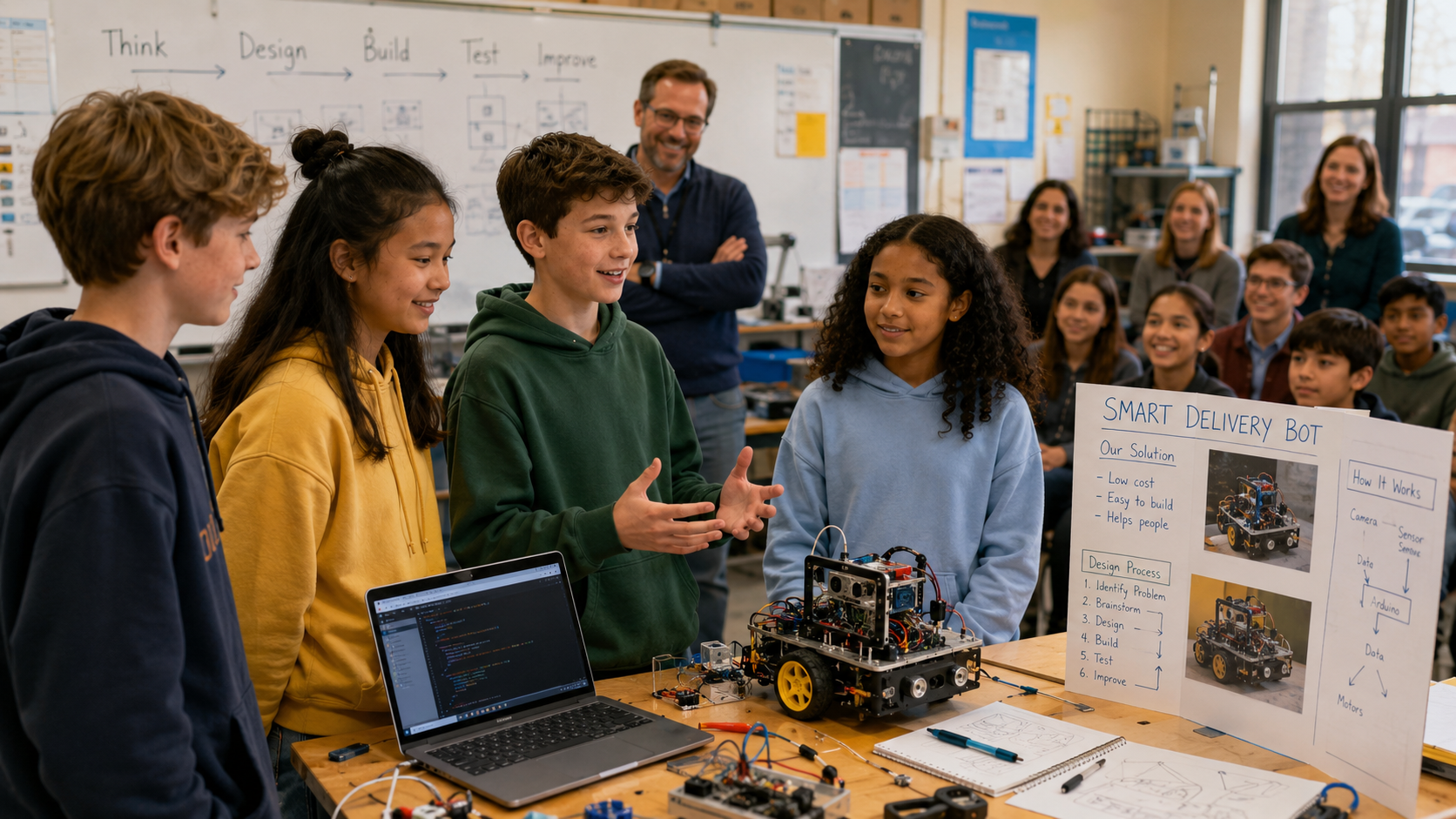
There is a particular kind of magic that happens when a child stops being told facts and instead is handed a real problem to solve. Give a student a worksheet about motors and sensors and they will memorize it for a test and forget it by summer. But ask that same student to build a robot that can sort recycling, or guide a blind person across a room, or water a classroom garden, and something entirely different happens. They become engineers. This is the heart of project-based learning, and in a robotics classroom it is the difference between learning about technology and actually creating with it. The journey from a first spark of an idea to a finished robot presented proudly to an audience is one of the most powerful learning experiences a young person can have.
What project-based learning really means
Project-based learning, often shortened to PBL, is a teaching method in which students gain knowledge and skills by working over an extended period to investigate and respond to an authentic, engaging problem or question. The key words there are extended and authentic. This is not a one-afternoon craft activity. A real project unfolds over weeks, sometimes a whole term, and it centers on a problem that actually matters rather than an artificial exercise. Crucially, students demonstrate what they have learned by creating a public product, something they share with and explain to people beyond their own classroom.
In this model the teacher’s role shifts dramatically. Instead of being the source of all answers standing at the front of the room, the teacher becomes a coach, providing a structure and stepping in to guide, question, and encourage while the actual thinking and building is done by the students. The learning is student-centered, which means the children make real decisions about how they work and what they create. They have, in the language of educators, voice and choice. For robotics this is a perfect fit, because a robot is by its nature a thing you build to do something, and that something can come straight from the students themselves.
It starts with a question worth answering
Every strong project begins not with a kit of parts but with a driving question, a challenging problem framed at just the right level of difficulty. The best driving questions come from the real world, and ideally they connect to the students’ own lives. One famous classroom project began when students were simply annoyed that the loudspeaker in their room was too loud, which became the question of how to improve the acoustic environment of their classroom. In another, a teacher whose son was born without fingers led his students to ask how they could build functional prosthetic hands for children, using 3D printing. Those questions are powerful precisely because they are real, they matter to someone, and there is no single tidy answer printed in the back of a textbook.
In a robotics setting, the driving question might be how a robot could help an elderly neighbor who struggles to carry groceries, or how to keep a small garden watered during a school holiday. The teacher launches the project with what is sometimes called an entry event, something that builds excitement and gets the questions flowing. From there, students themselves generate a list of everything they need to find out, and that list becomes the engine of the whole project. They are no longer learning about gears and code because they were told to, but because they need that knowledge to answer their own question.
Building knowledge through sustained inquiry
Once the question is set, the real work begins, and it is messier and more rewarding than a normal lesson. This phase is called sustained inquiry, and it means students spend real time asking questions, hunting down resources, and applying what they find. They might read, watch videos, interview an engineer, or run small experiments. Importantly, inquiry in a good project is iterative: students ask a question, find a partial answer, discover that answer raises new questions, and circle back again. Along the way the teacher weaves in the actual content that needs to be taught, the science of how a sensor detects light, the math of how far a wheel travels in one rotation, the logic of how a program makes a decision. The difference is that this content now arrives exactly when students are hungry for it, because they need it to make their robot work.
The engineering cycle, where ideas meet reality
This is where a robotics project comes alive, as students move from thinking to making through the engineering design process. They sketch and plan a first design, then build a rough prototype, a first attempt that is fully expected to be imperfect. Then they test it, and here comes the most valuable lesson of all. The robot will not work the first time. A wheel will slip, a sensor will misread, the code will send it veering into a wall. In a traditional classroom a wrong answer feels like failure. In project-based learning, this moment of failure is reframed as exactly what engineers actually do, through a cycle of critique and revision. Students examine what went wrong, give and receive feedback, and revise their design and their code. They test again. They fail a little better. They revise again.
This loop of test, reflect, and improve is the beating heart of both real engineering and deep learning. It quietly teaches the most important lesson a young person can absorb: that work is not simply right or wrong but always capable of improvement. Children who go through this develop what psychologists call a growth mindset, and they build resilience that serves them far beyond any single robot.
The public product that makes it all real
A project-based robotics unit does not end when the robot finally works. It ends when students present their creation to a real audience, and this public product is not an optional flourish but an essential element of the whole approach. Sharing the work with people beyond the classroom, whether parents, other classes, or judges at a competition, transforms the entire experience. It raises the stakes in a motivating way, because students want their work to be good when strangers will see it. It makes their learning visible and something they can talk about. And it builds the communication skills that matter as much as any technical knowledge.
Preparing for the presentation is its own rich learning. Students must be able to explain not just what their robot does but why they made the choices they did, what problems they hit, and how they solved them. They learn to tell the story of their project, often supported by a written report, a demonstration, or a display. Standing up and explaining your own creation to an audience is a genuine act of courage for a child, and pulling it off builds a confidence that lasts.
Why this approach matters
When all the pieces come together, the results go far beyond a working machine. Students who learn robotics this way come away with deep technical knowledge that sticks, because they earned it solving a problem they cared about. But they also develop the four skills educators prize most: critical thinking, collaboration, creativity, and communication. They learn to work in a team, to manage their time across a long project, to handle setbacks without giving up, and to stand behind their own ideas.
The robot, in the end, is almost beside the point. It is the vehicle, not the destination. What a child really builds, on the long road from a first sketch to the moment they switch on their creation in front of a watching audience, is the ability to take an idea in their own head and turn it, through persistence and teamwork and a great deal of revision, into something real. That is a skill no worksheet can teach, and it is one they will use for the rest of their lives.