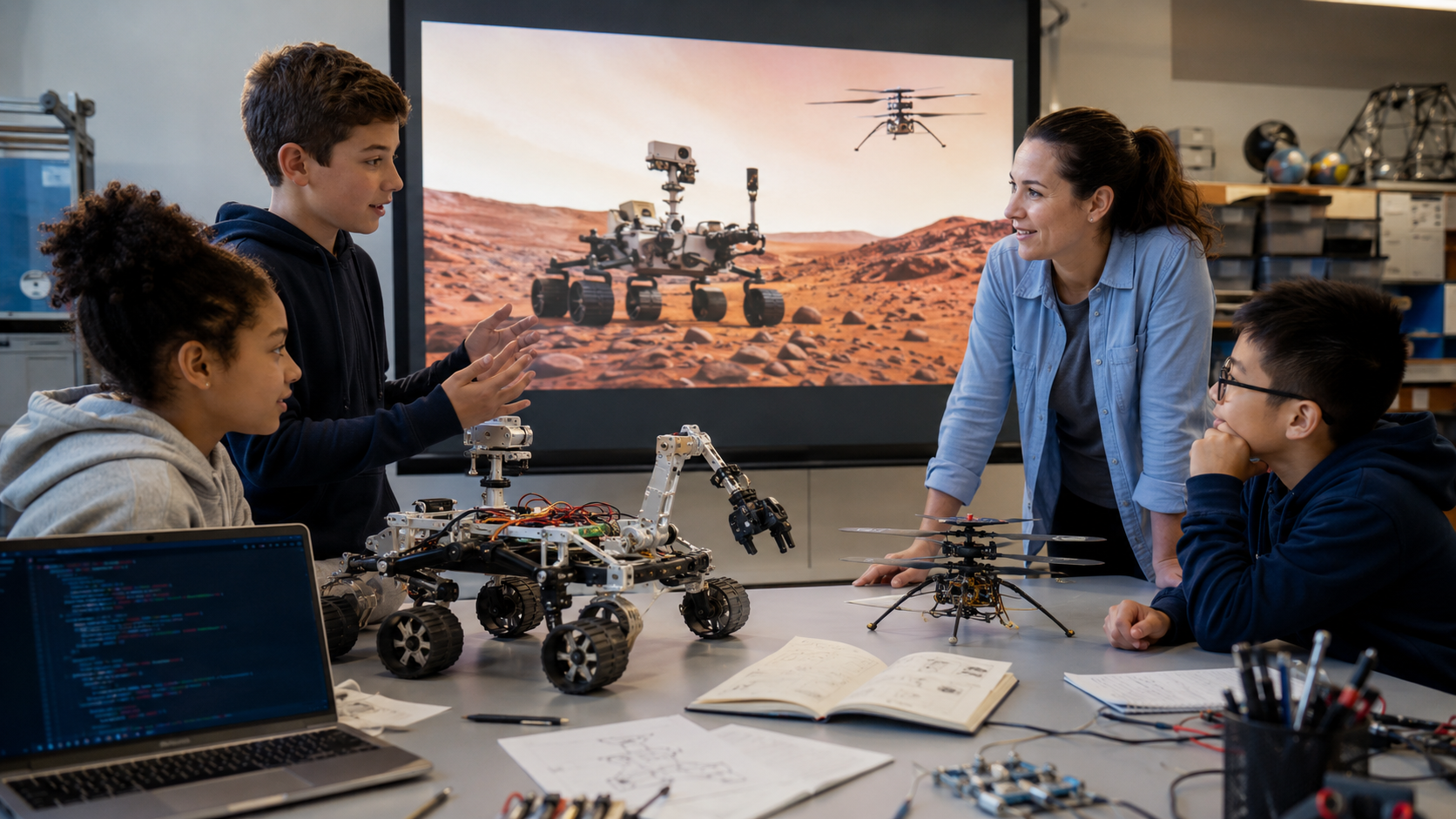
Somewhere on the surface of Mars right now, a car-sized robot is driving itself across an ancient dried-up river delta, drilling into rock, and searching for signs that life once existed on another world. It takes its own photographs, decides for itself how to avoid dangerous boulders, and sends its discoveries across hundreds of millions of kilometers of empty space back to Earth. This is not science fiction. It is space robotics, one of the most thrilling fields in all of engineering, and it has a remarkable power to light a fire in the imagination of young people who might one day build the explorers of tomorrow.
Space robotics exists for a simple reason: space is an incredibly hostile place for humans. The distances are vast, the radiation is deadly, the temperatures are extreme, and sending a person anywhere beyond the Moon is enormously expensive and risky. Robots solve this problem. They can be sent to worlds where no human could yet survive, work for years without rest, and take the dangers so that scientists back home do not have to. They have become our eyes, hands, and wheels across the solar system, and the machines themselves are marvels of clever engineering.
The most famous space robots are the Mars rovers. The current star of the show is NASA’s Perseverance, a six-wheeled rover the size of a small car that has been roaming a crater on Mars for several years now. Powered by a nuclear battery so it never has to worry about cloudy days, it carries a drill, a robotic arm, dozens of cameras, and even microphones that let us hear the sounds of another planet. Recently it achieved something straight out of a robotics dream: it began planning its own driving routes and figuring out its exact location on the Martian surface entirely on its own, without waiting for engineers on Earth to guide every move. Think about what that means for a young person fascinated by machines. The skills to build a robot that can think for itself in a place no human has ever stood are skills they could learn, starting today.
Rovers were not the first robots on Mars, of course. They follow a long line stretching back to the Soviet Lunokhod machines that trundled across the Moon decades ago, and the little Sojourner rover that first proved a robot could explore the Red Planet. Each generation taught engineers something new, and each was built by people who had once been curious students themselves. That is the quiet lesson hidden inside every mission: these incredible machines were not made by aliens or geniuses born knowing everything. They were made by engineers who started with simple questions and small projects and never stopped learning.
Perhaps the most magical recent achievement was not a rover at all but a tiny flying robot. A small helicopter named Ingenuity travelled to Mars tucked underneath Perseverance, and it made history as the first machine ever to achieve powered, controlled flight on another planet. Flying on Mars is fantastically difficult because the air there is barely a hundredth as thick as Earth’s, giving the blades almost nothing to push against. Engineers solved this with featherlight materials and rotors that spin many times faster than a normal helicopter. Originally meant to make just a handful of test flights, the plucky little drone exceeded everyone’s expectations and flew dozens of times over nearly three years before finally retiring. It proved that the dream of flying scouts on other worlds was real.
That breakthrough has opened the door to even more ambitious flying robots. Engineers are now building a far larger nuclear-powered drone, roughly the size of a small car, designed to soar across the skies of Titan, a frozen moon of Saturn with a thick atmosphere and lakes of liquid methane. Because Titan’s air is dense and its gravity is gentle, flying there is actually far easier than flying on Earth, making it a perfect playground for a robotic explorer. Each of the drone’s rotors is carved from a single block of aluminum, a beautiful example of the kind of careful, hands-on engineering that turns a wild idea into a working machine.
The frontier of space robotics is getting stranger and more wonderful all the time. Because ordinary wheeled rovers cannot climb into caves, lava tubes, or steep crater walls, engineers are dreaming up robots that hop, roll, and bounce. There are designs for small ball-shaped robots that can fly and hop across the Moon using tiny thrusters, and four-legged robots, a bit like robotic dogs, built to bound across the low gravity of distant worlds. Every one of these ideas began as a sketch on someone’s notepad and a question that started with the words “what if.”
This is exactly why space robotics is such a powerful inspiration for young engineers. It combines everything that makes building robots exciting and gives it the grandest possible purpose: exploring the universe itself. A child who learns to wire a motor, write a few lines of code to make a robot turn, or build a machine that can sense its surroundings is taking the very first steps along the same path that leads to a rover on Mars. The principles are the same whether the robot is rolling across a classroom floor or across an alien crater. Sensors, motors, programming, problem-solving, and above all the patient cycle of trying, failing, and improving.
The engineers steering robots across other worlds were often inspired as kids by watching a rover land or a tiny helicopter lift off. Some of the people who named these very spacecraft were students who entered contests to do so. The next person to design a robot that flies through the skies of an alien moon is, right now, a curious young person somewhere, maybe building their first simple robot and wondering how far it could really go. The answer, as space robotics shows us, is farther than anyone ever imagined.